Your dog's digital twin has got me worried
Pawel Halicki
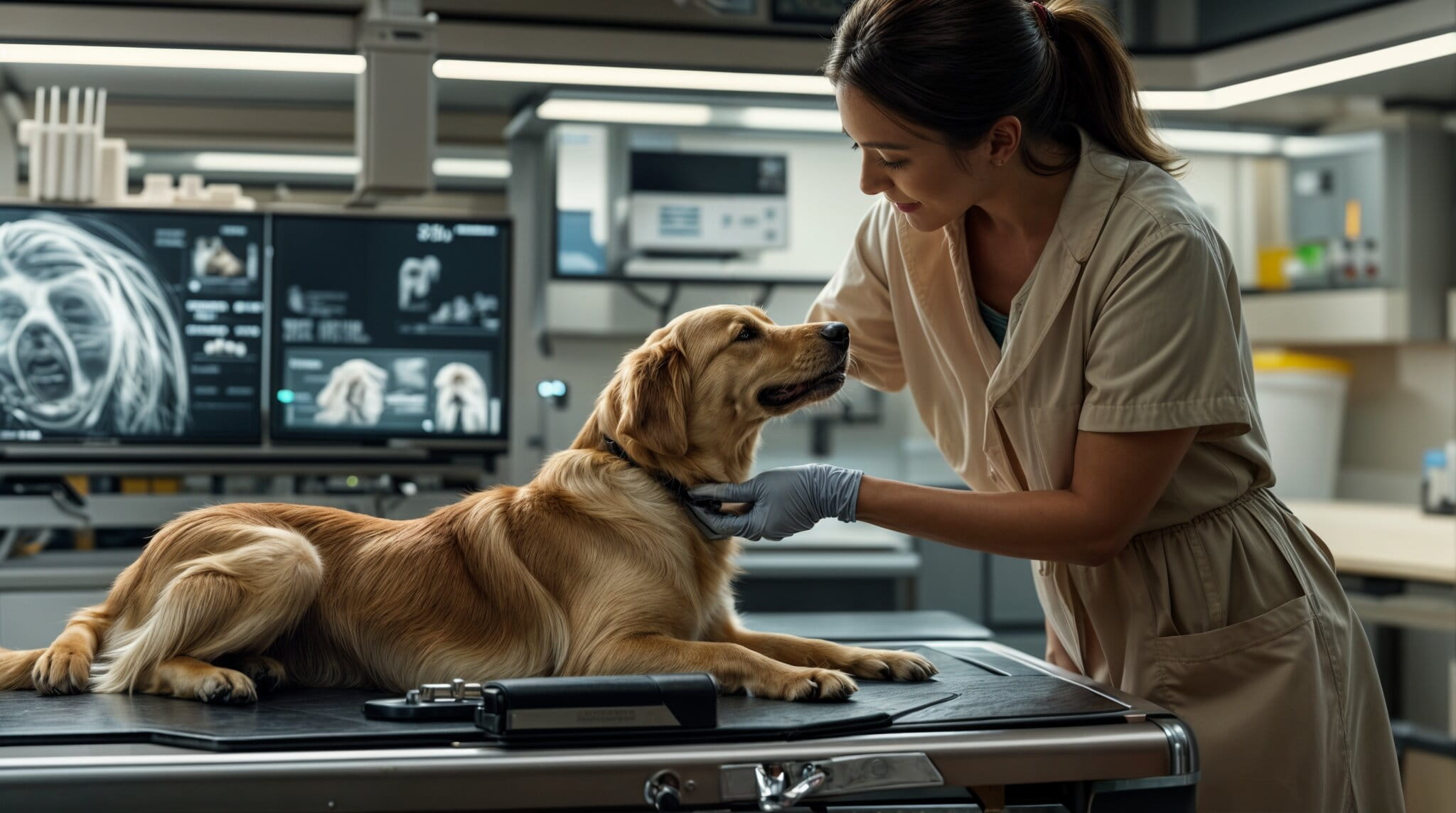
The reception area is busy with patients being weighed, measured, and groomed in automated stations. A subtle citrus scent mingles with antiseptic notes, while the soft green walls reinforce the serious but reassuring atmosphere.
- Hi, sorry, we don’t have an appointment. Her barkpad told us to come in right away.
The case is already waiting on the receptionist’s screen, synced from Luna’s collar.
- Luna, right? You’re already in the system. Please have a seat. The doctor will be with you shortly.
The anxious dog plants herself on the tile. Just when he gives up on the idea of dragging her to the nearest chair, a vet appears in the doorway, thin diagnostic strips glowing along the seams of her scrubs.
- Luna?
- That’s us. Come on, let’s see what’s up.
He stands up quickly and gently tugs the leash. They follow the vet through a corridor with white doors on both sides.
- Do they train you not to laugh at pet names? Some of those out there were wild.
- We do what we can, but some names are hilarious.
As the door shuts, the room shifts from green to blue, reacting to a stress reading the room has just pulled from her collar.
- Thank you for coming with Luna this quickly. We need blood to confirm what the screening is picking up.
- Is everything okay? The barkpad just said to bring her into any uplinked clinic as soon as possible.
He lifts Luna onto the inspection table and glances at the dog, who seems blissfully unaware of his worries.
- Time matters, but we’ve caught this very early. Without the barkpad, we probably wouldn’t see it until the symptoms became obvious in a few weeks.
As she examines Luna, her digital profile opens on the wall. Vitals, treatment history, and live flags resolve across the wallscreen.
- Did you notice anything suspicious in her behaviour?
- Not really. She’s as uncooperative and moody as always. Which paw?
- Front one. Left or right.
He steadies the visibly unhappy dog, who lets out a low grumble.
- It’s okay, it’s okay.
She takes the blood while he strokes the dog’s back.
- We’ll run the tests to be sure. Has she been scratching herself recently?
- It’s hard to tell. Same diet. Same few parks. Same walk routes.
She wraps the dog’s leg with a strip of patterned cohesive bandage.
- You can take it off in 15 minutes.
She inserts the ends of the tubes into the machine, which seals them with a hiss and flashes a network-readable trace tag across each vial.
- Okay, the hard part is over. You can put her down on the floor. Why are you looking at me like that?
- She wants her treats.
- Two vials, two treats? Please don’t give me this look. You know how to negotiate.
She gives Luna her treats, and they sit at her desk.
- Your dog’s digital twin has got me worried. The standard reference range for her age and breed is here.
She flicks a hand toward the wallscreen. A reference dog appears first, wrapped in baseline vitals. With another gesture, Luna’s twin snaps in beside it. Several markers flare red.
- These are the places where Luna is drifting off her expected range. On their own, they’re small. Together, they point to an emerging problem.
- Okay. But why a blood test? We could simulate the whole organism. Cell by cell.
- Because the model can infer, but it can’t confirm everything. Every so often, we need a hard sample from the real dog.
She smiles, noticing his puzzled expression.
- The twin is a working model of Luna. Her collar feeds it live data, but blood gives us what the collar can only infer.
- So what’s wrong with her?
- A mosquito bite may have exposed her to a parasite we’re seeing more often as warmer seasons push these vectors into new regions.
He nods, looking at his dog, trying to mask anxiety with humour.
- Zombie mosquito. Who would have thought?
- We used to catch this late, either by chance or once the symptoms were obvious. The alert escalated because her collar shares screening data with the regional vet net. Systems like this compare continuous screening against millions of cases pooled across linked clinics, so weak signals stand out sooner.
- I keep hearing there’s serious money in reviewing systems like this, especially if you’ve spent years handling unusual cases.
- Most medical tracks cover it now, but the real money goes to people with deep practice behind them. Reliable models need thousands of cases reviewed by clinicians, checked against lab results, and updated against real outcomes.
- Is it interesting?
- I still prefer hands-on care and can’t get enough of my patients. However, moving into clinical model supervision can be more rewarding for many doctors if they want to work with rare conditions or collaborate on global standards. For most doctors, it’s also one of the few credible ways to work remotely.
- So now the data does the doctoring?
- Only the screening. Judgment still sits with people.
- When will we know for sure?
- The test results will be ready later today. If they confirm the diagnosis, I’ll contact you. If everything is okay, we’ll continue to monitor her and repeat the bloodwork in a week.
- And if she’s infected?
- If it’s confirmed, we’ll send a medication pack your feeder can dispense on schedule, based on the prescription we push to the barkpad. Her barkpad will update the dosage schedule, and her twin will watch for changes in activity, temperature, and inflammation markers. Most dogs don’t need another blood draw unless their markers fail to settle. For today, that’s all. Do you have any questions?
- No, it’s clear to me. Thank you, and have a nice day.
As they walk through the clinic, he feels glad he decided to do this first thing in the morning. The separation cues pulsing across the waiting area are doing their best, but the morning rush has every species ignoring them.
Outside, he taps the call strip on the right temple of his glasses. The call connects, and his partner’s live feed appears before his eyes.
- Hey, I just left the vet. Luna’s okay for now, but they think she may have been bitten by a mosquito carrying a parasite that’s become more common as warm seasons get longer.
- Zombie mosquito? You can’t be serious?
He sighs.
- If the tests confirm it, they’ll push the treatment schedule and feeder update straight to the barkpad.
- I hope she’ll be nicer to be around than when you were dieting.
- You are so mean.
- I know, and you love it. Kiss Luna from me.
- I’ll see what I can do.
Memories to build from this future:
Try to recall the last time someone pointed out something about a person you see every day that you hadn't noticed yourself. You looked at them again. Same posture, same voice, same routine. But now you were searching for something you hadn't been looking for a moment ago.
Now, stay in that gap between what you see and what you've been told:
Think back to a regular week when a health twin, fed by a wearable, flagged a concern about someone in your care before you noticed any change yourself.
What shifted about how you read their day-to-day once the twin held a live baseline more detailed than anything you could track on your own?
How did you learn which alerts from the twin to act on right away and which ones to sit with for a few days?
Where did you draw the line between trusting the twin's reading and trusting what you observe directly?
Go back to a regular month after your team joined a pooled screening network where every routine case fed live data into a shared detection model.
What changed about how your team spots emerging problems once weak signals from individual cases became visible patterns pooled across the network?
How did your team's confidence in the network shift once a physical sample revealed something the pooled model had been inferring incorrectly?
Which definition of "normal" did the network's baseline quietly overturn once it drew on more cases than any practitioner could review alone?
Try to recall the year your organisation created a path for experienced practitioners to move into model supervision, reviewing flagged cases and calibrating the screening twin's predictions against real outcomes.
What shifted about how the organisation values hands-on experience once that experience became the data that trained better screening models?
What changed about how newer colleagues develop once the practitioners they would have learned from were calibrating twins remotely instead of working cases alongside them?
Where did you first notice the twin's predictions sharpening because someone with deep case knowledge caught a pattern the model had been missing?
Last thing on this one.
If continuous screening were already catching weak signals in your work long before you'd notice them, what would change about where your own judgment matters most?
What would you be curious to test first? And does anything from this one connect to ideas from other sessions?