Something to calm my metrics, please
Pawel Halicki

Settling in a counter chair, he hides behind the massive air scrubbing plant. Its BioLume leaves complement the café’s ambient lights. The barista is with him in no time.
- Welcome to Spaceholder, home of calibration brews. What can I get you?
- Something to calm my metrics, please.
- Date or business?
- You can call it a business date.
- How long until you’re on sensors?
- In about sixty minutes I have a one-hour pitch in a mutual biometric transparency setup. Then, an informal follow-up in a room where everyone’s readings are on the table. I need to show up calm and confident, not who my nerves pretend I am.
- Confidence without the static?
- Exactly. Last time I pitched, my anxiety bled into the session. It cost me 8% on the reliability index as the readout showed uncertainty I didn’t actually feel about the work.
- Mm-hmm. You want sharp, not jittery. Got it.
Once he palms the consent blinking on the counter, the barista starts arranging all the brews and tools.
- For a business date in a mutual transparency room, I’ll blend you something with sensor-friendly adaptogens. It won’t change how you think, but it will help your body stop contradicting what you know.
- Will it solve the problem?
- Nerves create noise. You know, worrying about metrics creates more anxiety, which worsens metrics. You’re confident in your craft, but your baseline says otherwise. Our brews help the signal match the source. You’ll read as exactly what you are: prepared and invested.
- I appreciate the help. This contract matters and I’d rather compete on my skills than lose to my own cortisol.
- That’s what everyone says when they walk in here. Any wearables synced today?
- Still wondering about this symmetric sync thing. It’s great to see conviction levels instead of second-guessing every smile, but I find it rather distracting.
- Have you heard of that CEO whose hacked smart socks vibrated to distract him right when he started to push back in high-profile negotiations?
- Haha. I should be alright. I’m just a simple overlay engineer.
- I see. Infused environments?
- Mostly personal workspaces.
- Nice. Your clients are expensing the cost, so nobody is trying to squeeze you?
- That’s the nice part. The hard parts are the efficiency gains expectations. Ironic, isn’t it? I design these infused workspaces to make people feel more in control, but I can’t feel that way in my own pitch.
- I feel you. The pressure to deliver can be draining.
- Well, it’s not people I’m trying to impress. It’s the scoring model.
- No worries. That’s why places like this exist. Transparency works best when everyone arrives as their actual selves. My job is to help people show up without the interference.
The barista sprinkles some expertly crushed auramatics and starts blending his order.
- This should help your readings reflect the competence you’ve built, not the butterflies from wanting it too much. The sensors will see someone who cares deeply and knows their craft - which is true.
- Thanks. I appreciate your help.
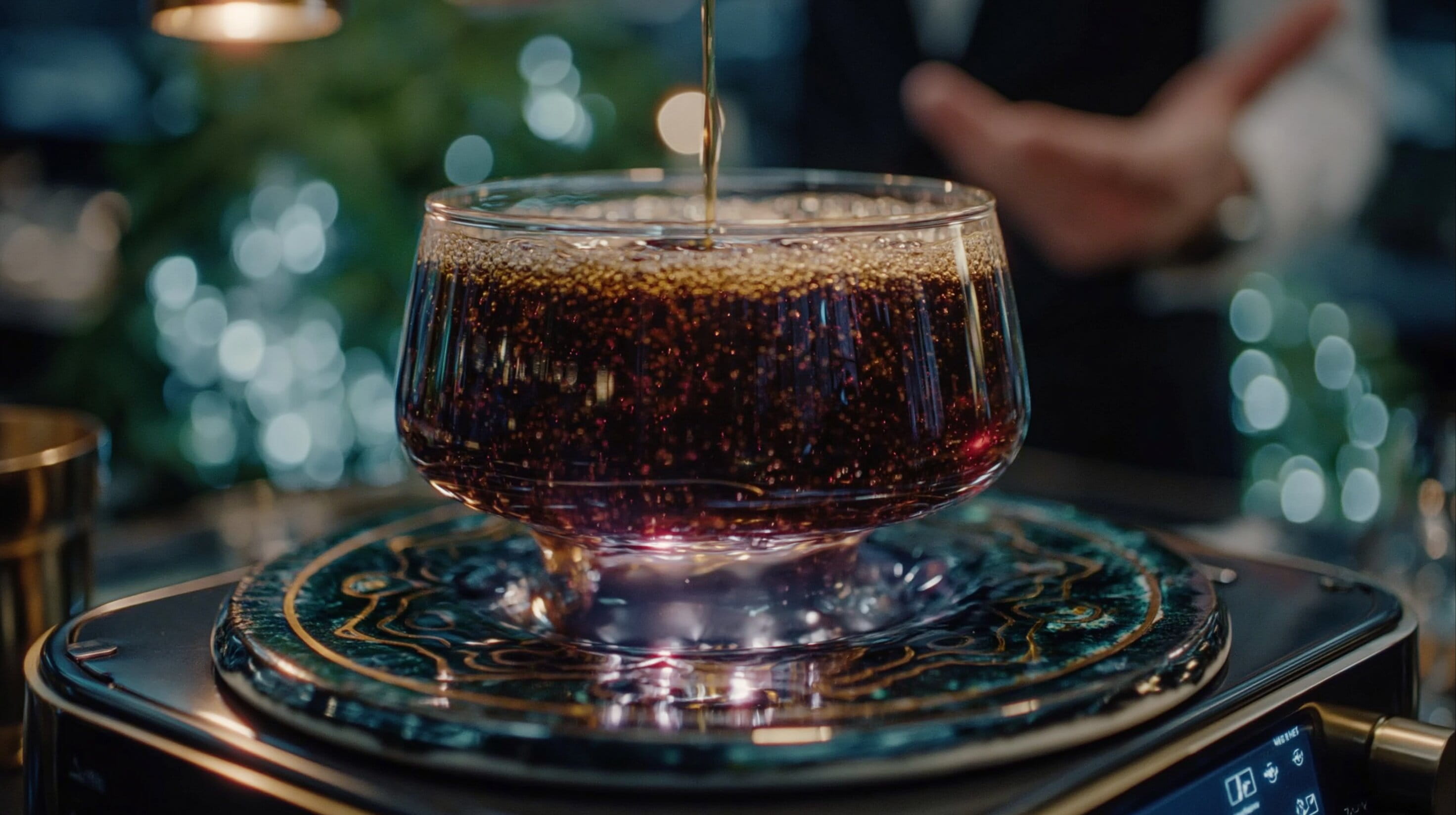
His coaster starts vibrating when the drink is poured, whipping the blend with micro bubbles into a tight vortex.
- Do you ever feel like you’re blending the rules?
- Honestly? I think the algorithms saved us from ourselves. People are sneaky. Models are blunt.
He nods, tasting the spicy herbals cutting through the pomegranate, with a rich aftertaste signalling the blends beginning to work. Another sip already tastes like the comfort of taking action.
- You’d be surprised how many clients tell me they prefer knowing exactly what good performance looks like. At least the system tells you the rules.
- Fair point.
He checks the time. Forty-five minutes. Enough.
- How much do I owe you?
- Fifty for the consultation. Tell me what the drink is worth when you land the contract.
He smiles, knowing the drink isn’t what decides that.
Memories to build from this future:
Try to recall the morning before something you cared about more than usual. You knew the material. You'd done the prep. But your coffee tasted like nothing, you kept checking the time, and there was a small fast feeling in your chest that didn't quite match how confident you actually felt about the work.
Now, sit with that mismatch:
Think back to a gathering where the room could read everyone's interest, and you found yourself drawn into a conversation you would normally have hung back from.
What changed about how groups welcomed quieter people once curiosity could be read off the room before anyone had to perform it?
Which conversations opened up for you because someone caught your interest signal before you'd found a way to show it?
How did your sense of who belongs shift once being heard stopped depending on speaking the loudest?
Try to recall a working session where your team's calm and conviction sat on the table next to the actual content.
What shifted in your team once you could see real conviction behind each position rather than practiced confidence?
When did visible uncertainty start being a tool your team coordinated around rather than something to hide?
How did your team learn to read the shared signals without getting tangled up in them?
Go back to a regular quarter after important talks in your organisation became two-way, with audiences sharing engagement signals back so people delivering could see what actually landed.
How did people start preparing for high-stakes talks once engagement signals would come back in real time?
What changed about how decisions got made once anyone presenting could tell the gap between what people said they understood and what they actually absorbed?
When did those engagement signals stop feeling like pressure and start feeling like the way to actually connect?
Before we wrap up.
If you could close the gap between what you know and what your nerves announce on your behalf, what would change about how you walk into the moments that count?
What small experiment would you be curious to try? And is there anything from this one that ties to ideas from other sessions?