Signal cooking is my buffer
Pawel Halicki
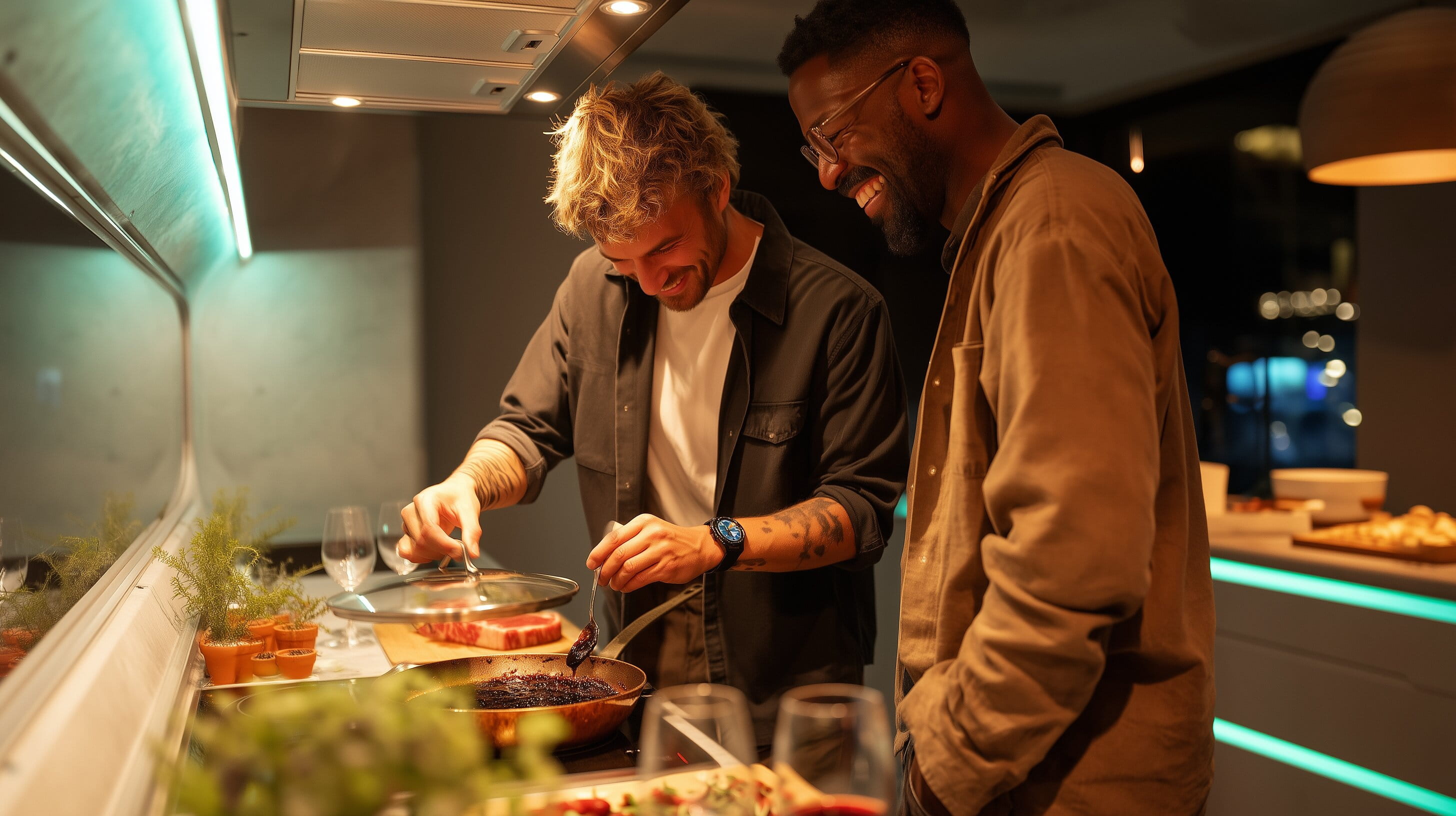
The familiar crowd spills into the kitchen from the adjacent dining area. He shouts at his cousin through the chatter.
- Hey, your stove just kicked into closed-loop again.
- Mm. Signal cooking. Sensored foods. I set the end state. The kitchen manages the drift.
- What are you cooking?
- It’s a surprise.
- I can see that. Isn’t it also a surprise for you? Do you actually know what you’re cooking?
- Not really. I knew the occasion, not the meal. The kitchen is shaping it around who’s here and what needs to be used.
- Hmm.
- I trust live feedback more than somebody else’s recipe. And you, what are you making?
- Mammoth steaks.
- Entertainment meats?
- Yup. Fully cultured. Same protein logic, better story.
- But cooking from scratch? Too many variables. I get enough of that at work.
- Oh, really? Hasn’t it got better recently with all those drones and robot firefighters?
The cousin grins, pointing to a cue blinking on the cabinet in front of him.
- My kitchen thinks you’re cutting those too thick.
- I like them thick.
- You like everything thick. That’s why your stew takes half a day.
- Good things take half a day.
- Easy thing to say when nobody’s calling you out of bed at three in the morning.
His cousin slides the tray of roasted root veggies in for a surface scan. A soft tone rolls back as the oven’s rail lights up.
[Next: mix in 5 min. Spray oil lightly. Maintain browning zone.]
After closing the oven, the cousin drags the active burner over to the waiting pan.
- Long shift?
- Always.
- Fire?
- Three. One real, two stupid.
He passes the bowl of herbs to his cousin, looking at him.
- You’re okay?
- Yeah. Just tired.
A soft pulse runs along the edge of the cabinet in front of the cousin.
[Burner one: Browning too fast. Reducing heat. Add oil.]
- That thing really relaxes you?
- Oh yeah.
- More than cooking the normal way?
- For you, proper means following a recipe. All shift, I’m choosing between bad and worse. Command gets three options in eight seconds. Guess who still has to pick one.
- I feel you. Nobody wants more data. They want to know what to do.
- Signal cooking is my buffer. And in here, my only stakes are burned vegetables.
- Well, my stakes are mammoth-size.
- This kitchen tracks heat, moisture, browning, and texture shifts. If things drift, it steers me back.
- So you’re not deciding much, then?
- More like responding.
- To what?
- To what’s actually happening, not what the recipe assumed. You trust instructions. I trust live conditions.
He points the knife at the cousin’s counter.
- And this helps?
- Yeah.
- Why?
- Because here it’s simple. That pan needs something. I do it. End of story.
The cousin takes a deep breath and continues slicing the veg into thicknesses projected on the cutting board.
- Like last night, the building’s emergency twin kept re-syncing and our drone feed kept freezing. My head is still spinning. But here? Nobody’s panicking. Nobody’s trapped.
- You used to laugh at me for being trapped inside my recipes.
- I still do.
- And now you’ve got the counter telling you when to flip your aubergine.
- It’s not one thing. The whole setup is working together.
- See? That’s exactly the kind of sentence that means you’ve gone strange.
He lifts the lid on a dark, sticky sauce, dips a spoon, and smells it.
- You made this?
- Sort of. The kitchen built the base.
- May I?
At the nod, he tastes it, then reaches for salt, pepper, and rice vinegar.
- It’s brilliant on timing, useless on salt. Proper cooking shouldn’t need that much help.
The cousin watches him with a grin.
- Bold statement from someone taking notes from a spoon.

Memories to build from this future:
Think about the last time you got home after a day where every choice carried weight. You picked up something small. Folding a shirt, sorting a drawer, watering a plant. Not because it needed doing, but because your hands needed something simple and the next step was obvious. Nothing depended on getting it right.
Now, hold onto that relief:
Think back to a night after a long day when you signal-cooked dinner, setting the end state and letting the kitchen’s sensors handle everything except your hands.
What changed about winding down once your kitchen only asked you to respond, never to decide?
How did it feel when the kitchen managed the variables, and your hardest choice was whether to add more spices?
When did the silence between live cues start giving you something that cooking from scratch never could?
Go back to a project where conditions shifted too fast for the original plan, and your team switched to live tracking, adjusting as the real data came in.
What happened to recurring debates once everyone could see what was actually happening instead of arguing about what the plan assumed?
How did trust build differently when the system flagged the drift before anyone needed to raise it?
Which part of the original plan turned out to matter less than the team’s ability to respond in the moment?
Try to recall a regular quarter after your organisation adopted closed-loop systems that manage sequencing, timing and corrections of routine tasks on their own.
What did people start spending their time on once the system handled the routine precision?
How did it reshape your organisation’s view on expertise once the repeatable work ran itself?
What did someone add from pure experience that the system wasn’t able to, and how did that change what your team values?
Before we close this one.
If deciding, not doing, is the hardest part of your day, what would change about how you unwind if the space you call home only asked you to respond?
What small shift would you be curious to try? And does anything from this one connect to the ideas from other sessions?