Narrative Microdosing is how you practise futures thinking and build your ability to navigate uncertainty. Instead of predicting whether this future will happen, you temporarily imagine that it already has.
Start with something familiar, then use the prompts to explore what this future could mean for you, the people around you, and the organisation or community you know. That turns an abstract future into specific possibilities, tensions, questions and language grounded in real life and work.
Repeat with more stories to build more futures you’ve already thought through, and more reference points for navigating change.
Three prompts. About 10 minutes. No right answers.
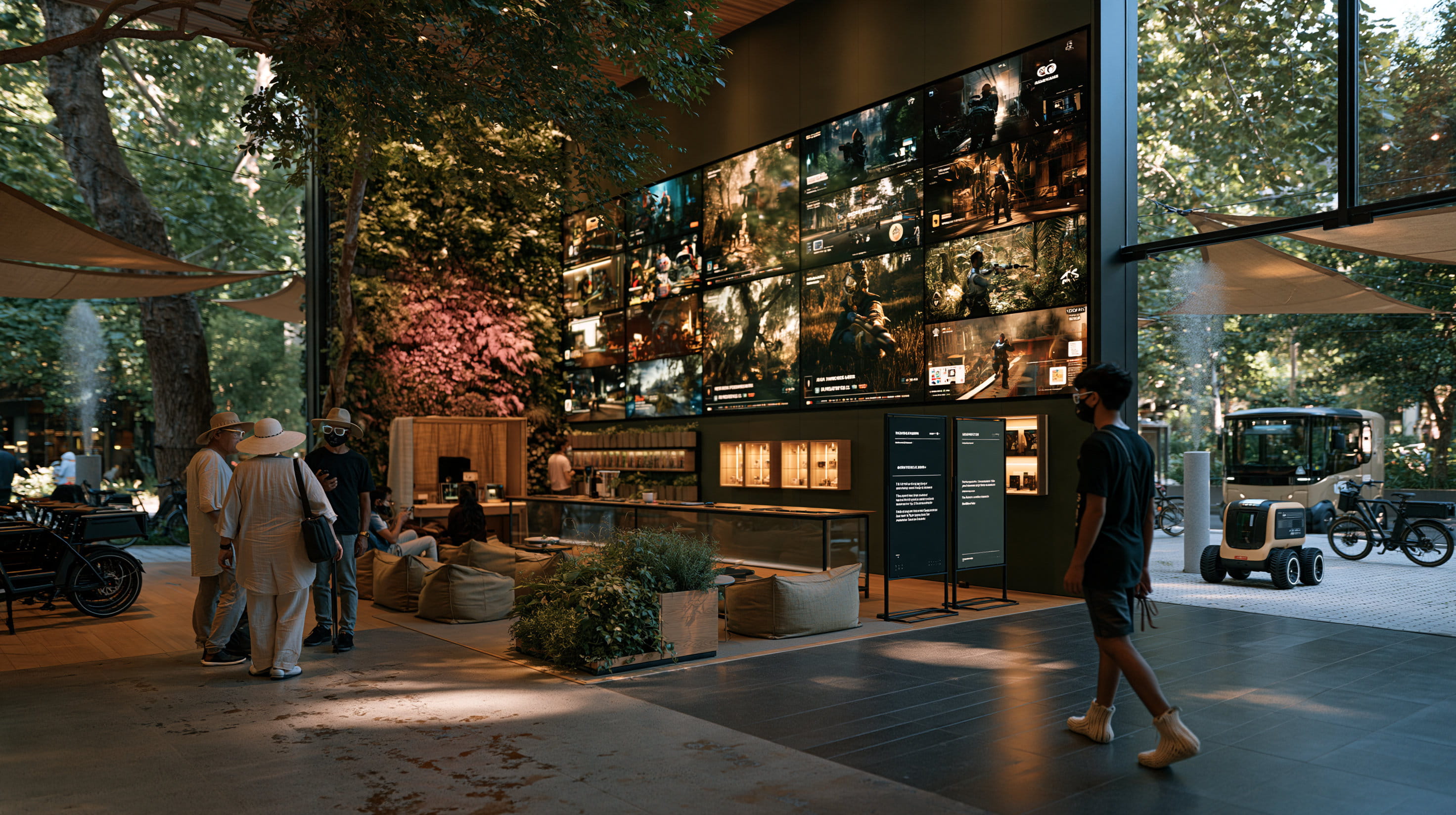
Video game stores have changed since his last visit. Trailers shift whenever he looks at them. Every game seems to want him as its next player. A teenager in front of him learns that buying another copy won’t get him unbanned, and leaves disappointed. A woman behind the counter turns to him.
— Hi, what can I help you with?
— I’m here to fill a game prescription.
— Of course. Just show it to the reader.
He holds his wrist over the reader. The display goes quiet once the prescription appears on the counter. An insurance authorisation follows.
— You’re insured with Forma Climadaptation?
— That’s right.
— It needs you to confirm you’re still covered.
He approves the request. Treatment details take over the display.
— Good. Your full treatment is covered, including clinical reviews.
She taps the company name with her glowing nail.
— Climadaptation? Are you the people doing the school roofs around the city?
— That’s another team. I work on older housing.
— Did you do the old market too?
— We did, actually.
— My mother lives above it. That was the first summer she didn’t have to move her bed into the kitchen.
He can’t help smiling.
— That’s good to hear. I’ll tell the team. We hardly ever get to hear that part.
The store employee turns back and browses the prescription section.
— Hmm. Nine weeks, three short sessions a day. Your clinician has cleared several settings. Anything you want to avoid?
— Anything with construction, I guess?
— Ha! Fair enough. You’ve got two good options.
She brings two Rx games onto the counter display. The first preview opens with a forest expedition on a strange island, the second with an intergalactic wedding reception.
— Both have the programme your clinician prescribed. You can choose whichever setting you prefer.
Intrigued by the variety of the guests, he opens the wedding preview. Someone who looks almost human is cutting the wedding cake into increasingly narrow slices. A holo message floats around the dining room, announcing that the groom’s arrival has been delayed.
— This looks interesting, but what am I supposed to do here?
— The wedding is just the opening. You will spend a year with this community, participating in celebrations, arguments and everyday problems. What happens depends on who you get involved with.
— So I have to try to fit in and figure out what’s up?
— Both. And nobody’s going to explain their local customs unless you ask.
— Will the game suggest what to ask?
— Only when you get stuck. Your clinician wants you to try your own ideas first.
He analyses the two games, looking for a recommendation besides the two titles. There isn’t one.
— I used to arrive on site and figure out what might be wrong. Now my assistant has a dozen explanations ready before I get there. I’ve spent ten years mostly checking them.
— And now?
— At the clinic, I picked apart twenty-eight suggested solutions. Every single one. Then they took the suggestions away and I could barely come up with two of my own.
— You’d be surprised how often I hear that. In this campaign, your goal is to work out what’s going on before anyone explains it to you. Later, you find out what you got right and what you missed.
— So surviving a year of alien small talk will make me better at my job?
— The game tracks your progress. Your clinician checks whether it’s helping with real-world problems during your scheduled follow-ups.
— Makes sense.
He touches the playable preview. A bioluminescent alien in a purple dress slips a place card into what looks like her bag. She catches him staring. Would you mind minding your own business? He looks for a menu of responses. There isn’t one. The alien waits, then mumbles something, annoyed by his silence.
— Oh. You really do have to think of something yourself.
— That’s the idea. Now, your insurer has authorised the nine-week programme and three follow-ups. Probability is not included.
— My doctor mentioned that.
— She’s marked it as optional. The standard treatment is covered either way, but add-ons are out of pocket.
— I heard extra probability helps, but what is it for exactly?
— It means the same situation can play out for different reasons. Say someone looks nervous. One time they’re hiding something. Another time, they’re just worried about food. You can’t just keep guessing until something finally works out. The game needs to see how you got there.
— And I have to figure it all out?
— Not necessarily. But you can’t rely on knowing the story already. It makes things less predictable. Not everyone needs that, but your doctor thinks it could be useful for you.
— Will the characters still make sense?
— Yes. The extra depth isn’t there to trick you.
— Fine. Let’s make it a little harder for me.
She adds the Probability Upgrade to his prescription. A payment request appears for the add-on. He glances back at another wedding scene.
— Hang on. Why are they cutting the cake if the groom hasn’t arrived yet?
— I have no idea. And even if I knew, I couldn’t tell you. Doctor’s orders.