My workspace will let you in
Pawel Halicki
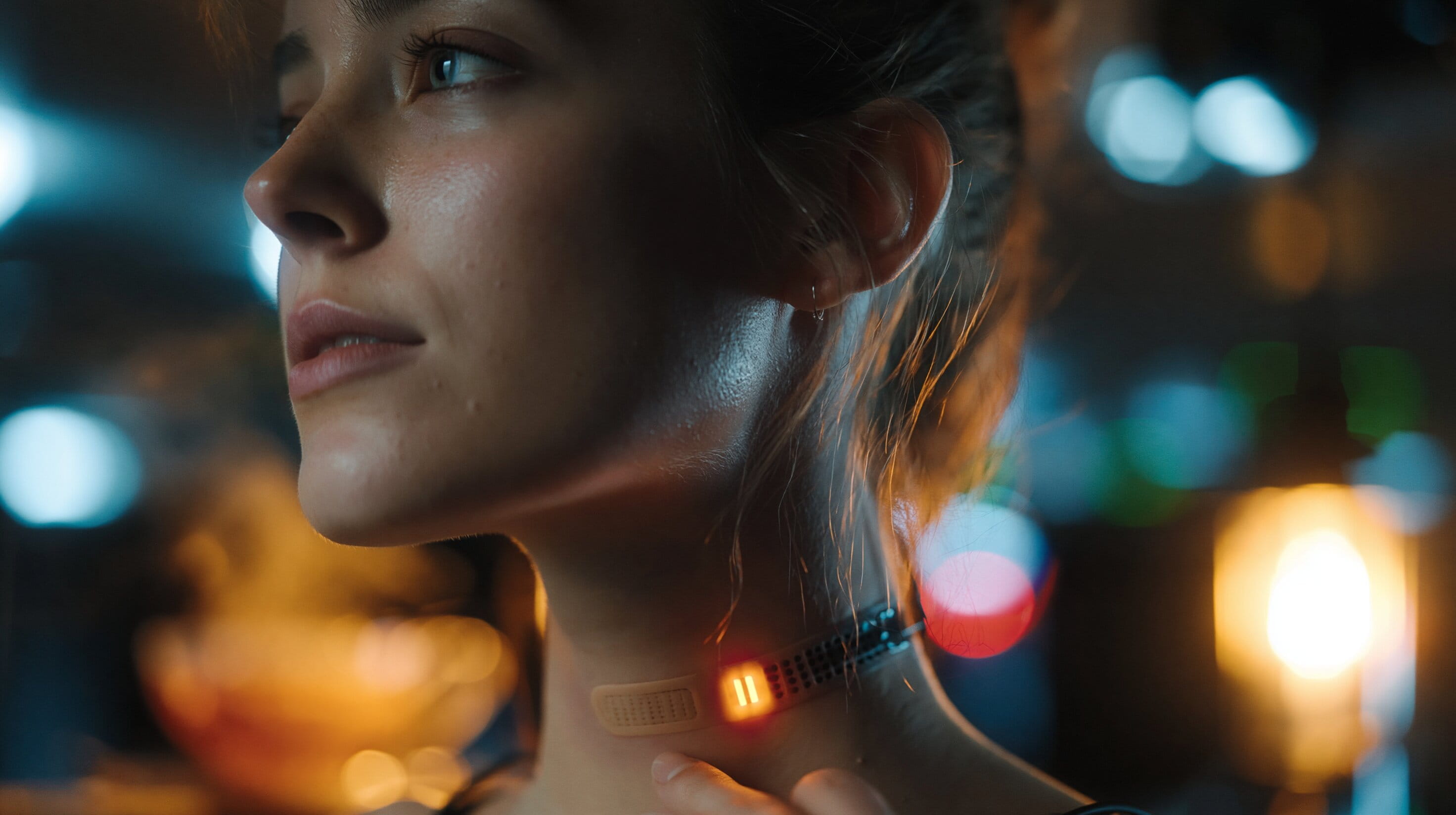
After two knocks, he opens the door. The hinge screams through the quiet cabin. Expecting his granddaughter at the desk, he’s surprised to see her on a spin bike, facing the wall like it’s a focus test.
- I got you the room with a view, and you’re staring at the wall?
He sets the tea and snacks tray on the desk between piles of paper and peel-off sensor strips.
- Ahem…
Tapping her neck, she clears her throat after recording words she didn’t quite say out loud.
- Thanks grandpa. It’s the least distracting background. Some of my tools get… needy once they see anything interesting.
- Oh. What are you working on?
- I’m trying to finish this paper on saving big animals. But I could use a break. Thanks for the tea.
She gets off the bike and crosses the room to get her cup. The tea warms her immediately. Her subvocalising patch flickers with a pause indicator.
- Subvocalising again? I’ll never get used to that.
- It’s amazing when you work in loud or shared spaces. You think in rough words. It turns them into clean text. And it’s so much faster when you don’t need to breathe.
- Still, never got used to it. Maybe it’s because of my mother?
- Since I was little, I remember she was the most talkative person I had ever known.
- Well, she lived through turbulent times, but her internal monologue vanished every time she got nervous. So she filled the silence out loud.
- Yeah, I remember her talking all the time.
They share a laugh at a distant memory.
- You think this is why you never got into subvocalisation?
- There are so many more interesting ways to externalise your thinking right now. Maybe I’m so good at what I already know how to use that I don’t care? The whole efficiency gain will be lost while I struggle to get comparably comfortable in a new tool. Anyway, what’s your plan?
She blinks, fingers worrying the edge of the patch.
- Well, I thought about staying a few more days if that’s not a problem, and later…
- Haha, you’re welcome to crash as long as you like. I’m only curious how you’re planning to save the big ones?
She flicks him an invite.
- Here, jump in. My workspace will let you in.
- Thanks.
He sinks into an armchair, hands on the armrests, and starts reading as the wall film turns matte and scrolls the draft like a teleprompter.
TITLE: Sensory Content Platform as Megafauna Preservation Strategy
ABSTRACT (WIP): Traditional conservation funding has failed. Current grant-dependent models have proven structurally insufficient to reverse megafauna population collapse.
Direct commercialisation of authentic animal sensory experiences via brain-computer interface technology offers an alternative by creating a content market capable of bridging the biodiversity funding gap. Neural access to recorded non-human perceptual states could be offered at price points similar to other entertainment markets.
Early market sims favour high-contrast, high-emotion experiences, easy to package into multi-user sessions: mid-Atlantic krill-swarm feast (blue whales), apex predator courtship (African lions), and high-stress defensive responses (Tasmanian devils).
- Plugging into sensory feeds of two whales feeding in the middle of an ocean? Now that’s a killer date idea.
- Well, that’s the concept.
He spots work-in-progress placeholders, waiting for her to pull live market data into the final version.
User demand for these experiences exceeds that of comparable premium entertainment content, with revenue projections sufficient to fully fund habitat protection, anti-poaching operations, and species management at scales currently dependent on fragmented global conservation grants.
Headings flash by as he scrolls further: Funding Gap, Market Demand, Pricing Tiers.
Revenue routing through a conservation trust with public audits. Content only sourced from animals already tagged for conservation research.
He whistles, nodding slowly in approval, like he hates how much he likes it.
After decades of failed attempts, species preservation demands a new business model.
- Well, I must admit this could be quite exciting, even for an old fart like me. Which animal would you wish to experience the world through first?
- Easy. Blue whale. I want to feel distance through sound. All those low notes you don’t just hear, you wear them.
- Would it even work?
- There is a lot of ongoing neuroplasticity research. With some training, we could learn to feel new senses faster than you think.
- I must admit I like the idea. And I can imagine it working. See? Eventually, everything turns into entertainment. Breadmaking, letterpressing, handwriting. Skills once capable of supporting entire families are a default hobby at most.
- Yeah, it’s such a shame that nowadays young people don’t even know how to shoe a horse.
- Exactly. If you’re reading my mind already, why do you have so many papers on your desk?
- On paper, nothing interrupts me. No suggestions. No assisted thinking. Just me and the mess. Only paper is as nonlinear as the way our neurons fire.
- Mine may fire in different ways. Whatever helps you think it through works. Every generation has its own medium. You’re writing this for study, aren’t you?
- Not really. This is a white paper for a problem board.
- A problem board?
- It’s a bounty board for hard problems where companies post problems, and people post fixes for prizes. Sometimes they hire the best problem solvers, and sometimes they spin their idea into a new product or business.
- Nice. I’ll be happy to read it once it’s ready. What’s the industry you’re curious about?
- Market modelling in complex games.
- See? Everything is entertainment when you’re clueless or exceptionally good at it. Maybe you’re right, saving the world requires an audience now.
Memories to build from this future:
Try to recall a moment when the helpful little suggestions on your screen got in the way of your own thinking. Not loud, just there, always ready to finish your sentence before you'd worked out what you wanted to say. You closed the tab and walked outside, and the thought you'd been chasing started arriving once nothing was waiting to catch it for you.
Now, stay in that silence:
Try to recall a walk when your subvocalisation patch caught a complex idea faster than you could have spoken it.
How did it feel to watch fully formed paragraphs appear almost from thinking alone?
What were you working on when you realised how much faster thought-to-text had become?
Which kinds of thinking still pulled you back to paper or silence, even when the patch could have caught them?
Think back to a workshop where nobody had to speak, because everyone could subvocalise their ideas at the speed of thought.
How did it change who got heard once being loudest no longer carried the room?
Which voices made it through that you'd never have heard in a normal meeting?
What did the silence give the work that overlapping conversations never could?
Go back to a quarter when your hardest problems sat openly on a problem board, and the best fixes kept arriving from people you'd never hired.
What kinds of work turned out to move faster once the problem board pulled in fresh eyes from outside your field?
How did your team decide which problems were worth putting a prize on, and which had to be solved in-house?
Which solution from outside your organisation changed something your team does every day?
Before we close this one.
If the thinking that takes shape only in silence had a real claim on your week, what would you have the nerve to keep out?
What small experiment would you be curious to try? And does anything from this one connect to ideas from other sessions?