Multiversing plans for a healthier you?
Pawel Halicki
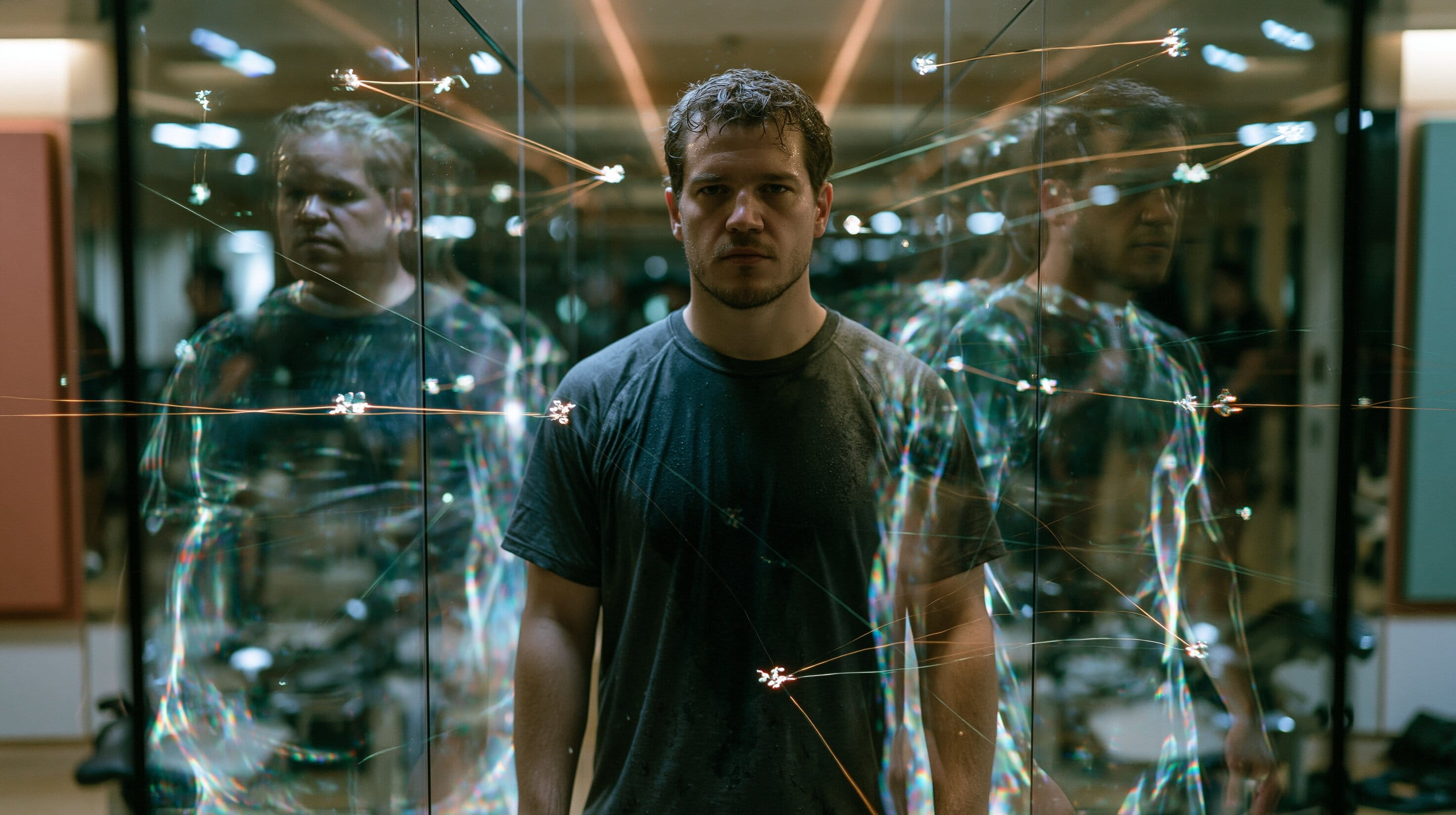
The changing room is quiet and almost empty. He is halfway to his locker when he notices the heavy man standing motionless in front of the gym’s body wall.
- You okay? You look like the mirror just gave you bad news.
The man seems transfixed by a collection of his own variants. Concerned, he steps closer and taps his arm.
- Everything alright?
The heavy man snaps back and peels off his drenched black shirt, revealing a slim soundband resting against his collarbone.
- I’m fine, thanks for asking.
- Oh, I’m sorry. I didn’t realise you were tuned into something.
- This?
The heavy man taps the device with a grin.
- A man needs his soundscape. Since gyms banned sound drones, this is the next best thing. Slap it on, and boom! Now I feel like a character in the end credits.
- What plan are you training on these days?
- SPS.
He pauses with one hand in his gym bag and tilts his head, intrigued.
- SPS? That’s a new one. Never heard of it.
The heavy man smirks.
- Strength on Mondays, Pain on Wednesdays, and Suffering on Fridays.
An old man walks in with a towel draped over his shoulders, catches the last line, and laughs despite himself.
- Fair. That sounds more honest than most programmes.
Noticing them staring at the mirror, the old man smiles.
- Ah yes. Multiversing plans for a healthier you?
- Just checking progress.
The mirror shimmers. The heavy man’s reflection holds for a second, then fans outward into versions of him: heavier on the left, stronger on the right, current body in the centre. A small disclaimer floats above the variants:
[Lifestyle simulation only. Clinical risk layer disabled.]
Thin animated paths connect each version to sets of tiny choices: number of sessions, protein load, sleep required, and recovery risk. Stress levels are blurred because the sync is stuck in a consent loop. They watch as the mirror calculates the heavy man’s progress trends. When the results appear, they can’t help but nod.
- Look at that. Week, month, quarter. All moving the right way.
- You’re on fire!
The heavy man sighs, pointing at his reflections.
- For twenty years, this thing mostly carried my head between meetings. Now I’m trying to make peace with the rest of it.
The old man adds.
- The first part is just convincing your body it’s a new habit, not an emergency. And sometimes progress is just not making your future self pay interest on today’s mistakes.
- That’s the idea. Multiversing after workouts makes the progress feel more real.
The old man leans in again.
- I hate those things.
The heavy man raises his eyebrows at the confession.
- Why?
- Well, not these gym ones. The medical ones at the doctor’s. At least here it’s muscle, weight, sleep and recovery. At the clinic, it’s organs, risk bands, and surgery timelines. I don’t need to meet every version of myself that way.
- It’s one thing to hear the doctor say it. It’s another to see the version of you who listened.
- Or not.
- Call me old-fashioned, but I don’t like it. The moment it shows me a version of myself, I feel like I’m being pushed towards it. Like the choice has already happened.
- I get that. It’s much harder to ignore doctors’ orders when they’re not words and numbers but your future versions. It’s not saying this is what will happen. It shows you dozens of possible versions of your future self, all with messy little confidence bands around them. Eventually, one starts to feel reachable.
The old man smirks, unconvinced.
- This is why they put those mirrors all over the place. You push harder when your goal feels reachable. That’s why old visions of the future look so funny now. Always the same perfect tomorrow for everyone. These mirrors work because they show the mess.
- Everything is hard to ignore when it looks real.
- Or talks to you in your own voice because some growth team discovered people can’t ignore their future selves for long.
For a moment, none of them laughs. The old man shivers.
- Multiversing creeps me out. Maybe it’s because I’m not sure how it works, but it feels invasive, like it’s manipulating my identity.
- Every new mirror feels like theft until people get used to what it gives back.
- Yeah, yeah, but do you even know how it works?
He keeps changing, explaining almost on autopilot.
- Multiversing visualises a sequence of potential outcomes extrapolated from current data.
Both stare at him blankly, so he shrugs, pulling on a fresh T-shirt.
- Sorry. Overexplainer syndrome. It works like recreating 3D models from photographs. It builds a body model from images, patches in plausible changes, then runs those changes against your habits, training history, sleep, food, injuries, all of it. Like future-facing photo editing. The boring terms are photogrammetry and inpainting. The useful part is that it doesn’t just show fantasy bodies, but paths that could produce them.
He packs his vivid adaptive trainers into the gym bag, continuing.
- Pick a goal, make the model sweat, and it gives you a hundred possible routes. Choose one, adjust the variables, and update as you go. Picking a path makes you more invested in achieving it.
He zips up his cooling hoodie and grabs his bag.
- And now I’m rambling. That’s all the free tech support you’ll get out of me today. Any fun plans for the weekend?
- Nothing special.
- Dinner with my partner’s family on Saturday.
- I thought Friday was for suffering. Wasn’t it?
The heavy man chuckles, syncing progress to his account.
- I’ll be fine. They’re nice and cook great food.
- Lucky you.
He presses [Finish] on his locker and heads for the exit.
- See you on Monday.
- Have a good one.
As he leaves, the locker blinks, starting the disinfection cycle. Behind them, the mirror resets to idle, wiping away all the potential physiques, apart from the one saved for Monday.

Memories to build from this future:
Try to recall the last time you watched someone like you do the thing you'd been telling yourself you'd get to one day. Same kitchen layout, same kind of tools, same hours in the week. For a second the gap between you and them stopped being about willpower and became a question of when.
Now, sit with that smaller distance:
Try to recall the months you took coaching from a simulated variant of yourself who had already reached the outcome you were working toward.
What did that variant already understand about the harder days that you hadn't worked out yet?
How did the advice land differently when it arrived in your own voice from a simulated version of you who had already done it?
Which habit quietly fell away once a variant without it became someone you could actually listen to?
Think back to the week your augmented team multiversed a problem and watched potential solutions arrive, each with an action plan to get you there.
What shifted in the team's conversations once each option arrived with the steps already mapped?
When did a generated path turn out to be more useful for understanding the problem than for solving it?
How did the problem itself look different once dozens of plans for solving it sat side by side?
Go back to a regular day after multiversing had become the default way your organisation approached major decisions.
What changed about the appetite for ambitious bets once the plan behind each option was open for review?
How did the value of human instinct transform inside your organisation once a generated path was available for almost any choice?
Which decisions did your organisation agree to keep as conversation, instinct, and judgment rather than generated variants and plans?
Before we close this one. If a goal you've been treating as aspirational arrived with the path to reach it attached, what would shift in how you'd approach it? What small step toward that would you be curious to try? And does anything from this one connect to ideas from other sessions?