I’ll forward you their hugs
Pawel Halicki
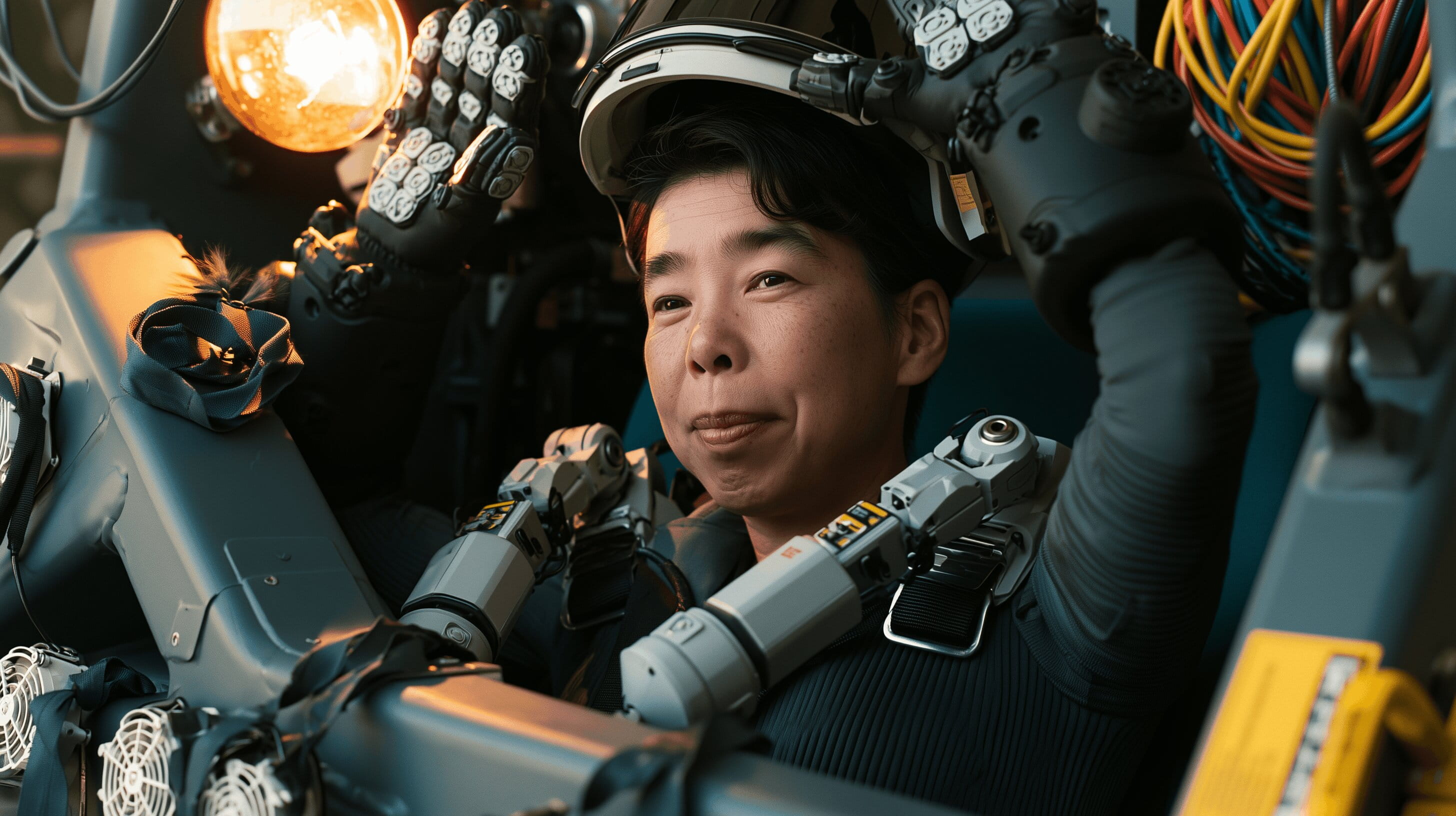
The floor technician checks that the previous link has cleared from the operator’s suit and brings up her next assignment.
— Offshore turbine. Vibration sensor. Routine replacement.
— Same robot?
— Same one. It’s already on the enclosure. It asked for support.
— Crew?
— Three onsite. Final day of rotation. None cleared for drivetrain work.
The suit tightens around her body, checking pressure and resistance, while the gloves test each finger in turn. The visor lowers. The facility disappears.
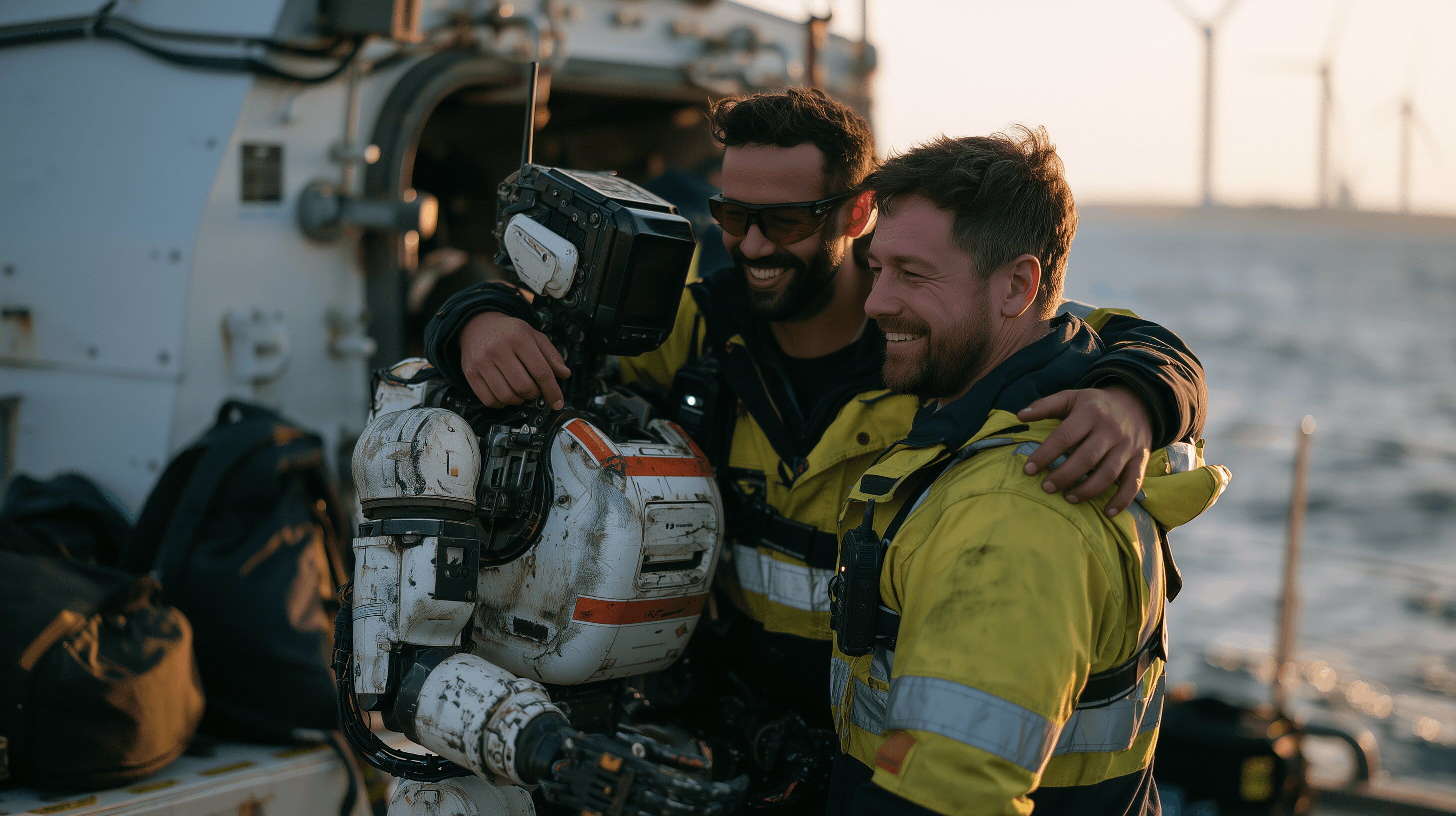
Wind arrives first, translated into broad pressure across her shoulders. Her balance settles on a steel platform high above a grey sea. The maintenance robot’s left hand rests against the turbine housing. Beside its right foot sits an open case of tools.
A worker in high-vis overalls stands beside the machine, one hand resting on its arm. He looks into the robot’s cameras.
— Hi there, who’s in today?
— Remote response.
— Oh, it’s you again.
— How can you tell?
— You always flex the hands before speaking.
— Show me the sensor.
The sealed drivetrain turns beneath them at diagnostic speed. One of the turbine panels is already open. The worker points to a vibration sensor mounted against the drivetrain casing. A status message remains open beside it.
[Autonomous intervention paused. Approved force limit reached. Human review required.]
— The monitor flagged it three hours ago. The robot swapped the sensor, got the same fault, then tried reseating the mount and hit the approved load limit.
— At least it knew when to stop.
The operator crouches beside the assembly and puts two robotic fingers against the metal mounting pad. Her haptic suit returns the turbine’s vibration as a dull tremor. She asks for slightly more pressure. The robot holds the pressure steady while the changing vibration returns through her gloves. When she lets go, the peak returns.
— The reading shifts when I press the mount.
The onsite worker points at the display.
— So the sensor is faulty?
— The replacement reads the same. I’m escalating.
She pings a specialist channel.
— Escalating to a specialist already?
— The robot won’t apply any more force, and its touch sensors can’t give me anything finer. I’m not diagnosing drivetrain harmonics through oven gloves.
— Nothing ever happens out here. We’re still using an old utility model.
— I can tell.
A new presence icon lights up in her visor. Another voice joins the channel.
[Equipment Engineer: Audio and data connected.]
— Asset and fault.
— Offshore wind turbine. Drivetrain vibration anomaly. The resident robot hit the approved force limit while reseating the sensor. The replacement shows the same reading.
— Send me the live trace.
The operator shares it.
— Got it. Press the mount again.
— I just did.
— This time don’t try to solve it.
The operator places her fingers against the metal.
— Increase pressure gradually.
The waveform shifts. The expert is silent for a moment.
— I need control.
— You can see the data.
— I can see what changes. I need to feel why.
The engineer’s presence indicator changes.
[Equipment Engineer: Sensory link active.]
The operator opens the control menu.
— Warm transfer. I’ll stay in the link.
— I can clear this faster if you let go.
— And I can clear this one next time if I stay.
The onsite worker looks into the robot’s cameras.
— Excuse me, how many of you are in there?
— Two.
— But only one in control.
The operator releases control. The suit tightens around her body in the bay while the robot stays braced against the turbine.
[Control request verified against active work order. Control transferred.]
Her hand lifts on someone else’s intention.
— Still hate that.
— You asked to stay connected.
Under the expert’s control, two robotic fingers press the centre of the pad, then its upper edge. The change travels back through the suit into the operator’s fingers.
— There.
— I felt it too.
— The sensor is rocking on the mount.
The onsite worker checks the diagnostic trace.
— The register says it’s part of the housing.
— The register has never touched it.
The expert removes the sensor and runs one robotic finger around the pad.
— This isn’t the original mounting pad. It’s compatible, but whoever fitted it left one edge high.
— So the sensor is working?
— Perfectly. It’s just listening to the wrong thing.
The expert signs a one-use repair instruction. The tool case releases a fine dressing strip. Under the expert’s control, the robot works down the raised edge. The operator feels the roughness fade beneath her fingertips. The expert reseats the sensor and tightens it in short stages until the irregular peak disappears.
— Control back. I need to know how you fitted it.
— The sensor is already fitted.
— Feeling you fix it isn’t the same as knowing how. Stay while I try.
The expert returns control. The operator loosens the sensor slightly.
— Too far.
— Then let me find too far.
She reseats it, adjusting the pressure while watching the signal.
— Slower.
— You were faster.
— I knew what I was feeling.
— That is what I’m trying to learn.
The waveform settles. The onsite worker starts another low-speed verification sweep. The trace remains clean.
— Verification passed.
The expert says nothing. The operator waits.
— Good?
— Adequate.
— Expert for good?
— That’s expert for stop touching it.
The expert leaves the sensory link but stays on audio to sign the chain-of-presence record. The robot feels emptier, even though the operator controls it again.
Two more onsite workers emerge from the access stairs. They leave their bags beside the housing and gather around the maintenance robot. The first worker wraps both arms around its torso. A translated squeeze closes around the operator’s ribs. The others join him, smiling as they embrace the resident robot.
— You do this every rotation?
— We never leave without hugging the one who never flies home.
A new request flashes beside the expert’s presence indicator.
[Specialist required: Desalination pump.]
— I’ve got to go. The pump’s waiting.
The operator clips the last few seconds of the haptic feed.
— I’ll forward you their hugs.
— Thanks. I appreciate the gesture.
Memories to build from this future:
Go back to a moment when someone taught you something with their hands. Maybe kneading dough, tying a knot, holding the scissors the right way. They stopped explaining, put their hands over yours, and moved.
Your body suddenly understood everything that the words had failed to say. It was knowledge, but it felt like care.
Now, take that feeling further than arm's reach:
Try to recall the evening you linked in and volunteered through a robot body in a storm no one should stand in, partly for the good, mostly for the thrill.
How did it change what counts as brave once the storm was real to feel but couldn’t reach you?
Who volunteered beside you once nerve mattered more than strength or health?
Which jobs nobody used to want became the ones people queued for?
Think back to the morning your whole team put on their haptic suits and felt one expert run the hardest part of the job, every hesitation and correction arriving in your own body as it happened.
What became easy to agree on once everyone felt the same moment themselves?
How did training change once ten people could learn from a single run instead of waiting for their turn?
Which impossible-to-explain parts of the work stopped needing explanation at all?
Go back to a regular quarter when the specialists your organisation had waited months for became bookable by the hour, arriving through the robot bodies where the work was.
Which stubborn problems stopped being a problem once the right expert could be there within an hour?
What did your own team get better at once the rarest skills no longer had to be on staff?
When did renting out your own rarest skill, by the hour or in residence, start to look like a real career?
One last thing on this one.
If the right expertise could reach any problem around you within an hour, what would move first? What small experiment with far-away help would you be curious to try?
And does anything from this one tie to ideas you’ve been carrying from other sessions?